Visiting the Pont du Gard
Two thousand years old, 49 metres high, and the most impressive single thing in the south of France. A practical guide from people who live fifteen minutes away.

Jan-Willem & Fleur
La Valette Boutique
Sanilhac-Sagriès, 30700 Gard, France
Two thousand years old, 49 metres high, and the most impressive single thing in the south of France. A practical guide from people who live fifteen minutes away.
The Pont du Gard is a first-century Roman aqueduct bridge in the Gard, southern France, built to carry water toward Nîmes. At 49 metres high it is the tallest surviving Roman aqueduct and a UNESCO World Heritage Site. The bridge is visible for free from both riverbanks; parking and the museum are paid. It lies about fifteen minutes by car from Uzès, and swimming is possible in the Gardon below.
| Location | Vers-Pont-du-Gard, near Uzès |
|---|---|
| Region | Occitanie |
| Department | Gard (30) |
| Height | 49 m (tallest Roman aqueduct) |
| UNESCO status | World Heritage Site since 1985 |
| Distance from Uzès | 15 km · about 15 min by car |
| Nearest airport | Nîmes (FNI), about 35 min |
| Typical visit | 1.5 to 4 hours |
| Parking | Paid, both banks (Rive Gauche, Rive Droite) |
From fifteen minutes away
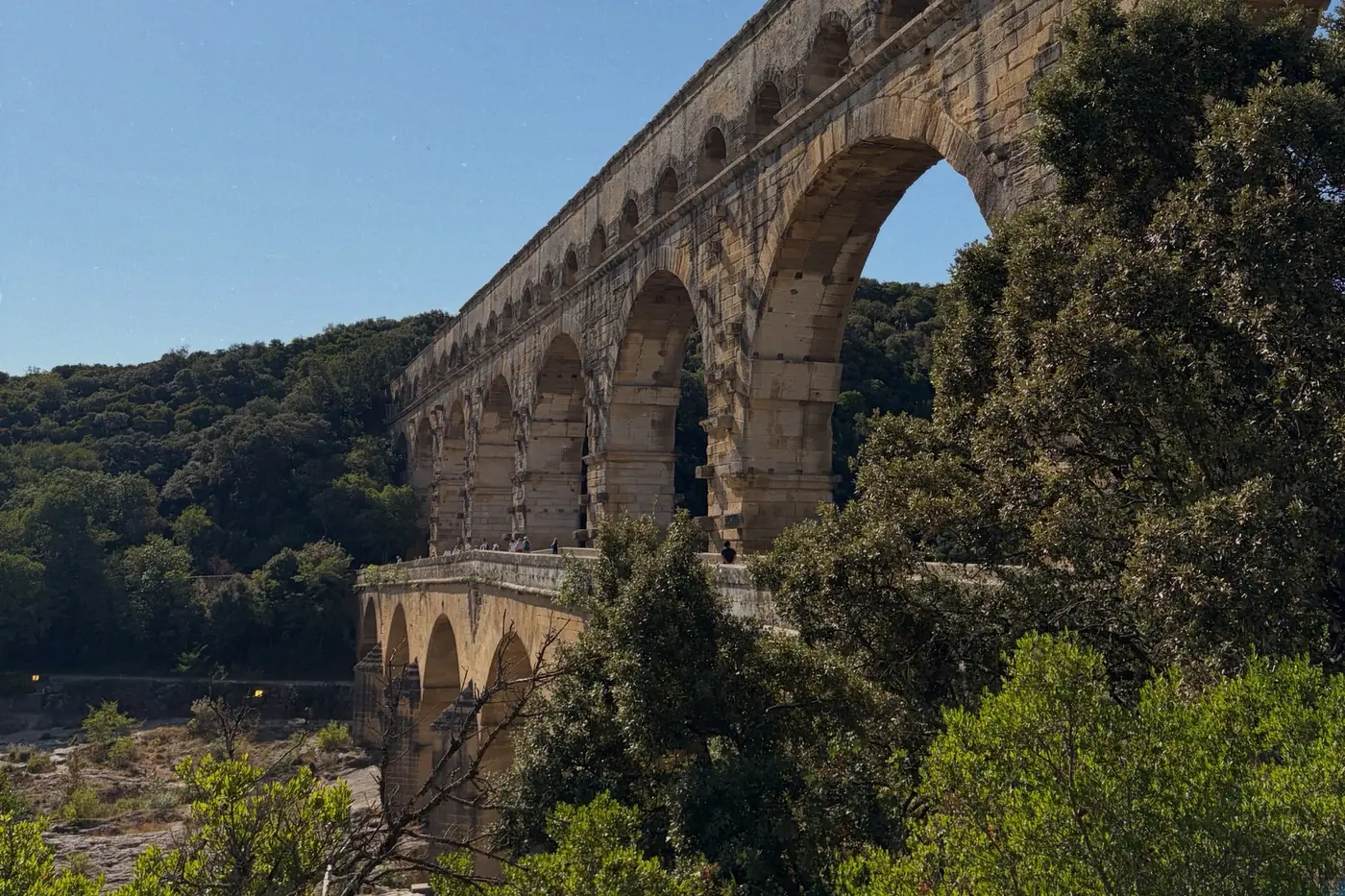
We knew the Pont du Gard was large. Every photograph confirms it. What photographs do not convey is the silence around it in the early morning, or the fact that the river Gardon below it is clear enough to see the bottom. The combination of a Roman engineering work on this scale with a swimmable river at its base is something that becomes real only when you are standing at the edge of it.
The season changes the visit. Early October, with the summer crowds gone and the light lower, is a quieter time to come. In high summer the only advice worth giving is to arrive before 9h or after 17h, because midday in July is the busiest and hottest window.
The official site, pontdugard.fr, holds current ticket prices, museum opening hours and event listings. We recommend checking it before visiting.
What it is
The Pont du Gard is the surviving river-crossing portion of a 50-kilometre Roman aqueduct that once carried water from a spring near Uzès to the city of Nîmes. Built in the middle of the first century AD, the bridge stands 48.77 metres above the Gardon and is the tallest Roman aqueduct bridge that survives anywhere in the world. It became a UNESCO World Heritage Site in 1985.
The structure spans 275 metres at the top tier and is composed of three stacked levels of arches: six on the lower tier, eleven in the middle, thirty-five along the top. None of the stone was set with mortar. The Roman engineers cut and stacked each block so precisely that the aqueduct has stood for two thousand years without falling.
"Go early in the morning, before the coaches arrive. At seven in June, the light comes from the east across the Gardon and the stone is still cool. You have it almost to yourself."La Valette Boutique, the Gard, 15 min away
Beyond the basics
When to go
The site receives over a million visitors a year. The difference between a transcendent experience and a crowded one is almost entirely about timing.
Arriving at opening means the monument before the coaches. Morning light hits the stone from the east. Leave La Valette at 8h30, park at Rive Gauche, walk to the bridge.
Tour groups leave by mid-afternoon. From 17h the crowds thin significantly. The summer light is warm and low from the west.
July and August from 11h to 15h: car parks full, paths crowded, heat intense. Go directly to the river and swim first.
Practical information
Swimming
The Gardon runs directly under the Pont du Gard and is one of the best swimming spots in the region. The water is clear, relatively shallow in summer and cold enough to make a real difference on a 35-degree afternoon. Swimming is permitted in designated areas on both banks.
The left bank has a long beach with a gradual entry, good for families; the right bank has deeper pools. The official site rules matter here: no swimming within 30 metres upstream or downstream of the bridge (suction around the piers), no jumping or diving from the aqueduct or the rocks, and the left-bank cliffs between the bridge and the Vieux Moulin are closed. The beaches are not supervised and swimming is at your own risk. There are more swimming spots along the Gardon that we share with guests.
The light show
Each summer the Pont du Gard hosts a free evening video projection on the aqueduct, and the programme changes every year. The left-bank gallery hosts a changing exhibition each season; pontdugard.fr lists the current one.
Next summer, check pontdugard.fr for the dates and the best viewing side. From La Valette the bridge is fifteen minutes by car; the projection is free and parking is €9 per car per day.
Full day combinations
Morning at the bridge, swim until noon, drive to Uzès for lunch on the Place aux Herbes, afternoon in the old town. Fifteen minutes between the two.
Take the road north into the Gorges du Gardon. Extraordinary canyon landscape, mostly unvisited, accessible on foot, by kayak from Collias, or by road bike from the house.
Thirty minutes separates the bridge from the Roman city: the best-preserved arena in the world, the Maison Carrée, the Jardins de la Fontaine.
Dinner in Uzès first. In summer, when the projection runs, drive the fifteen minutes to the bridge, then return to La Valette for a late glass on the bistro chairs by your door.
The bridge itself is free to see from the paths on both banks, on foot. Parking is paid: €9 per car per day. The discovery spaces (museum, cinema, play area, temporary exhibition) have a separate ticket: €8 adult, €6 reduced, free for under-18s, students and visitors with a disability; the guided visit up to the aqueduct is €15. Check pontdugard.fr for current prices.
Yes, at your own risk. The Gardon runs directly below the aqueduct and people swim from roughly June through September. The left bank has a long beach with a gradual entry, good for families; the right bank has deeper pools. There is no lifeguard on duty. Official site rules: no swimming within 30 metres upstream or downstream of the bridge (suction around the piers) and no jumping or diving from the aqueduct or the rocks. Water temperature is around 18 to 21 degrees in summer. After heavy rain the current can be strong.
Early morning (before 9h30) or late afternoon (after 17h). The site receives over a million visitors per year and midday in July and August is the busiest window. Morning light from the east is particularly good for photography. From La Valette, you can be at the bridge in fifteen minutes.
A quick visit to see the bridge and walk across takes about 1 to 1.5 hours. Add 45 minutes for the museum. Add 2 hours if you want to swim in the Gardon. A full morning or afternoon with everything included takes 3 to 4 hours.
Yes. There are far fewer visitors in winter and the structure is just as impressive. You would not swim, and the museum, cinema and exhibition spaces are closed (in 2026 from 2 November), but the site and its walking paths are open every day from 8h to midnight, and the light in the gorge on a clear December morning is remarkable. Parking stays at €9 per car per day all year.
There are two car parks, both at a flat €9 per car per day. Rive Gauche (left bank) is the most direct route to the bridge, roughly 7 minutes walk on a shaded path. Rive Droite (right bank) is quieter and gives a different perspective. In July and August, arrive before 9h to be sure of a space.
La Valette Boutique is in the Gard, fifteen minutes from the Pont du Gard, five minutes from Uzès. Two boutique apartments in an 18th-century stone house.
Enquire about your dates